Eve Lacey online lecture: ‘Mothers and Children of the Early Turkish Republic’, 19 January 2021 - flyer:
Interview
1- As a political exile Albert Eckstein was barred by the Nazi regime in Germany from practicing his profession as a paediatrician from 1935 onwards and received invitations to work in both Glasgow and the US but chose to accept the offer from Turkey. Presumably the pay and conditions were better in Turkey yet it was a way poorer country still recovering from the ravages of war from a generation earlier. This clearly points to a national vision in that country to improve the lot of baby / childcare in the hinterlands of Anatolia and do you think there was also a humanitarian side of Eckstein that welcomed this challenge in a country where dangers such as malaria still lurked?
There were limitations to the Glasgow and US job offers: the Glasgow children’s hospital contract included the caveat barring Albert Eckstein from taking an exam that would allow him to compete with British paediatricians and, while a job in America had been promised, he was told that the position would not be confirmed until he arrived in the US. The Turkish offer to transform Ankara hospital into a University clinic and to “establish a complete baby and children’s medical care system in Turkey” was much more ambitious.1 This assignment would have been particularly appealing because it was essentially the same task that Albert Eckstein’s father-in-law, Arthur Schlossman, had undertaken in Germany a generation before.
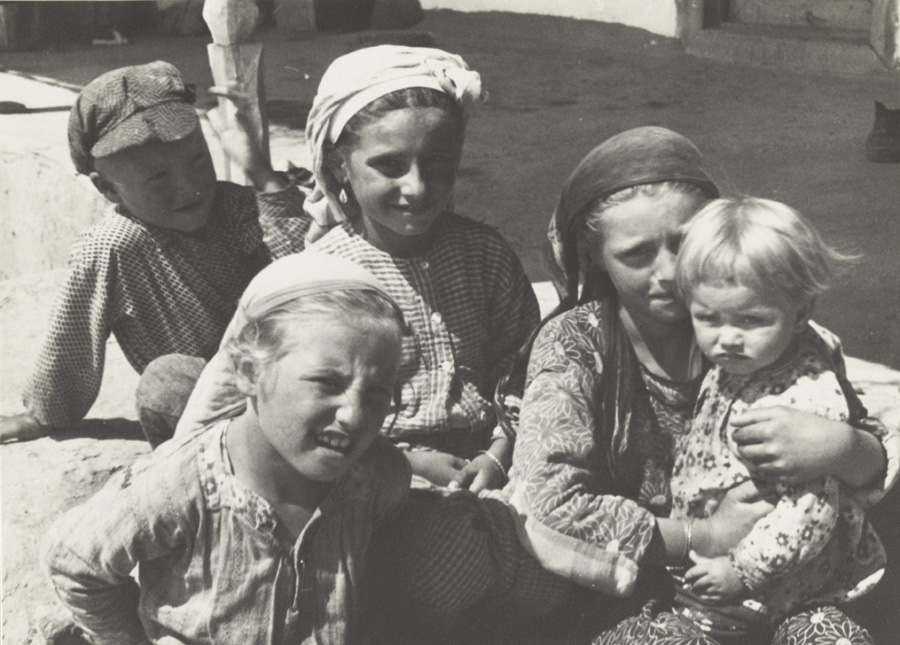
2- There are nearly a 1000 photographs in the collection which points to more than 'occasional holiday snaps' and often seemingly carefully composed and with the subjects clearly at ease and consenting. This points to a degree of systematic recording, yet not of a medical nature at all. Do you think this was purely Eckstein's way of personally connecting with his patients and making a record for his own memory or do you think the state asked for this and received copies for their own promotion / propaganda purposes to encourage the villagers to further cooperate with homegrown and foreign doctors?
I don’t know if the photographs were part of the official medical commission, but Erna Eckstein (Albert’s wife) records that the opportunity for taking photographs usually arose while they worked as doctors, when “women came with their children to the marketplace where we ran an outpatients’ clinic”.2 The state must have had access to at least some of the photographs because one image was used on a 10 Lira banknote. In terms of propaganda and promotion, the Ministry of the Interior used Eckstein’s footage of Turkish women to represent the nation at the New York World Fair in 1939.
3- During Eckstein’s stay in Turkey infant mortality fell from 33% to 12% which is clearly very significant and I presume water quality and general sanitation were very much part of that success. So do we have indications that Eckstein worked as part of a government team where his primary responsibility was health care while his Turkish associates would concentrate on advising and dealing with the sanitary infrastructure of these villages?
I don’t have evidence that he was travelling with a wider government team, but improvements to water quality and general sanitation were certainly taking place in the same period, and earlier. Lilo Linke, another German who travelled around Turkey in 1935, suggests that medical and infrastructural changes were strongly linked in the eyes of the Anatolian villagers who met Doctor Fehmi: “There were still certain stagnant ponds left from the great flood of 1932, dangerous breeding-places for mosquitos. Could the doctor send them the benzine motor-pump from Adana so that they could discharge the water on to the dusty road?”3
4- Eckstein also kept diaries over the years in German. Do these diaries have a more personal reflection side or do you think he also wrote them for others to also read perhaps later, so do they include any figures, charts, advise for the future etc.?
The diaries do include occasional charts, but his notes were not purely clinical – they also include observations from train journeys and comments such as ‘[i]t is touching how the older girls mother the younger siblings’.4
5- Have you been able to access the professional notes Eckstein forwarded to the Government?
The findings and recommendations of Eckstein’s medical commission were written up in a government medical journal, where he used data from the 1935 census to analyse population distribution and argue that the public policy of Turkey should concentrate on its youngest generations.5 His findings were also published in the British Medical Journal (1946),6 in which he argued for the validity of an “occult malaria” that did not display normal symptoms in children, and his more social observations appeared in La Turquie Kemaliste in 1938: “If there are older siblings, they take care of the baby with a maternal instinct, decreasing the mother’s burden”.7
6- Eckstein was also the personal doctor to some members of the Turkish establishment and when the daughter of the Turkish ambassador in Vienna got seriously ill during the early years of WW2 he was persuaded to travel and treat her and reluctantly agreed and having saved the girl also brought back with him some Austrian Jews in the return to Turkey. Do you know how this was achieved? Was he ‘dressed as a Turkish diplomat’ to achieve this dangerous mission?
The Ecksteins became friends with Şakir Kesebir, Minister of Economy and Agriculture, a few months after their arrival in Ankara, when Eckstein treated his nephew for typhoid fever. In April 1939, Şakir’s five-year-old daughter, Tülün, fell gravely ill in Vienna. Germany had just invaded Austria and Erna was reluctant for her husband to go, but Atatürk assured them that Albert would be constantly accompanied by an attaché from the Turkish Embassy. By the time Albert arrived, the child was blue in the face with an inflamed chest and blocked heart. After an immediate operation on her thorax and pericardium, Tülün started breathing again. Eckstein stayed in Vienna for three weeks, during which time eight of his acquaintances (three of them doctors at the hospital) killed themselves. When Şakir Kesebir’s wife returned to Turkey, she brought a Jewish doctor, a Social Democrat nurse, and a woman whose fiancé had already escaped the Nazis with her on a diplomatic passport.8
7- So this research by you will lead to a book. Do we have a publication date?
We do not have a publication date for this research but will keep you updated.
1 Erna Eckstein-Schlossmann. Home for me is really nowhere in particular. Personal notes with a contribution from Albert Eckstein, ed. Lorenz Peter Johannsen. Unpublished English typescript. For Hentrich & Hentrich Berlin Jewish memoirs series, Autumn 2012. 27-28. ↑
2 Erna Eckstein-Schloßmann. Memories of Turkey. unpublished typescript, written 1975, translated 1989. 9 ↑
3 Linke, Lilo. Allah Dethroned: A Journey through Modern Turkey. London, 1938. 254 ↑
4 Albert Eckstein, Katrin Bürgel, and Karoline Riener. Wissenschaftsemigration Im Nationalsozialismus: Der Kinderarzt Albert Eckstein (1891-1950) Und Die Gesundheitsfürsorge in Der Türkei. Quellen Und Forschungen Aus Dem Universitätsarchiv Düsseldorf, Bd. 2. Düsseldorf: Universitätsarchiv Düsseldorf, 2005. 37 ↑
5 Albert Eckstein. ‘Türkiye Nüfusunda Muhtelif Yaş Gruplarının Tuttuğu Yer ve Çocukların Umumî Nüfusa Nisbeti [1935 Senesi Nüfus Tahririne Istinaden]’. Sıhhiye Mecmuası 14, no. 93 (Auğustos 1938). ↑
6 Albert Eckstein and W. C. W. Nixon. ‘Congenital Malaria’. The British Medical Journal 1, no. 4446 (1946): 433. ↑
7 Albert Eckstein. La Turquie Kemaliste (1938). 10-14. ↑
8 Erna Eckstein-Schlossmann. Home for me is really nowhere in particular. 42 ↑
Questions by Craig Encer, March 2021
More information on Eckstein The Skilliter Centre for Ottoman Studies website / Cambridge Digital Library: