Alp Eren Topal online lecture: ‘Opposition in Exile: Namık Kemal in London (1867-1870)’, 27 July 2021 - flyer:
1- Was Namık Kemal the first Ottoman reformist thinker? For ideas did he have any home-grown intellectuals of earlier generations to draw upon?
Namık Kemal was by no means the first reformist thinker in the Ottoman Empire. Calls for reform by Ottoman bureaucrats and statesmen could be traced back to the early 17th century and even earlier. Of course, the concerns were different in each century and suggestions for how to reform varied accordingly. The point is that a narrative of “Ottoman decline” gradually developed through such text and turned into a grand narrative with which Namık Kemal and other Young Ottomans were quite familiar. Such reform proposals and debates particularly intensified in the late 18th century and the first half of 19th. In fact, Namık Kemal would frequently cite figures like Mustafa Reşid Pasha (d. 1858) who was a reformist bureaucrat often hailed as the chief architect of Tanzimat. Still, Kemal and his friends were the first to equate reform with a representative and constitutional government.
2- Namık Kemal’s father Mustafa Asım Bey was the chief astrologer in the Sultan’s Palace. How important a role was this at the time and did this naturally feed into Namık Kemal’s early exposure to the court and courtly languages of the time, so Arabic and Persian and with that all the literature and Islamic thought at the time?
By the mid-19th century the chief astrologer would not be a particularly important post, yet the fact that Kemal’s father was a figure associated with the Ottoman court would be a key to Kemal’s early education. He would receive private education in Arabic and Persian and classical literatures of these languages as well as Turkish prose and poetry. Also, his connections to the palace circles enabled Kemal to easily make a name for himself as a man of letters.
3- In 1857, at the age of 17, Kemal worked in the Palace Translation Office but because of the political nature of his external writings, Kemal was forced to leave this job by the Grand Vizier and so joined his friend and fellow Young Ottoman, İbrahim Şinasi, on his newspaper Tasvir-i Efkar (‘Herald of Ideas’). Şinasi was an early proponent of a constitution for the Empire and he strove to promote the proliferation of European Enlightenment ideals during the Tanzimat period, and he made the education of the literate Ottoman public his personal vocation. Do you think Şinasi should be considered as important and influential as Namik Kemal today and do you think Namik Kemal’s patriotic writings, which only constitute a minority, were selectively cherry picked by later leaders and thus his profile eclipses all those other ‘Young Ottomans’?
We do not know much about Şinasi’s political ideas except that he was obviously a generally liberal figure. He did not write on politics at all and he would deliberately distance himself from political struggles of the Young Ottomans, preferring literary activities and most significantly his work on a Turkish dictionary which, unfortunately, did not survive. Still, it would be safe to assume he had an influence on Kemal with his emphasis on the education of the public. As for Kemal’s patriotism, I would not say his patriotic pieces were deliberately cherry picked by the leaders although he has indeed been promoted as mainly a patriot and his political writings were mostly ignored. I would rather argue that this selection process was more organic in the gradual development of Turkish political ideas whereby Tanzimat thought was constantly downplayed as a naïve form of liberalism. The same applies to the other Young Ottomans who were no less patriotic than Kemal.
4- Namık Kemal was also a playwright and without doubt his most important play with which he is still known is ‘Vatan yahut Silistre’, set in the Crimean War where one of the protagonists is the lover of a soldier who wears military uniform to conceal her identity to share the same fate whatever that might be, so a love story set in nationalistic tones. Do you think the strong female role here was also problematic for the authorities, in addition to the crowds who would leave the theatres in a state of nationalistic fervour which the authorities had difficulty interpreting? Are any of Namık Kemal’s plays ever staged today in Turkey, which looking from the outside still has a strong nationalistic streak
It is a possibility that the strong female figure might have been problematic from the perspective of authors, although I do not think it would be at the top of the list. Such plays and literature still circulated among a narrow literate public whose immediately political demands were much more threatening for the government. Kemal’s plays are no longer staged and I believe there are several reasons for that. First, the transformation in Turkish language particularly through republican policies has put a significant distance between Kemal’s prose and contemporary Turkish audience. Also, Kemal’s plays are among the first examples of modern Turkish theater and as such I imagine they would be rather simple for contemporary audiences. We also need to consider the fact that Kemal (and Kasap too) thought theater’s main function to be the moral education of the public and that’s why their main intention was incite romantic patriotic feelings and instruct proper moral conduct for the new citizens. Those plays are deeply embedded in their cultural and political context, which makes them less appealing to a modern viewer.
5- The Young Ottomans’ efforts directly led to the first attempt at constitutional monarchy in the Empire in 1876, when the short-lived First Constitutional Era ushered in the writing of an Ottoman constitution and the creation of a bicameral parliament. Was it the precarious military and financial state of the Ottoman Empire that made this experiment in liberalisation a still-born child in the eyes of the Sultan and his advisors? Did the Western Powers lean in either direction or try to exert pressure?
Actually, it was the precarious military and financial problems as well as the unrest in the provinces that motivated the Young Ottomans and pro-constitution bureaucrats like Midhat Pasha. They believed the constitutional setup would reduce excessive spending by allowing accountability, and also bring non-Muslims closer to the state by providing representation through a parliament. The Ottoman constitution has generally been perceived as a concession to European powers but Aylin Koçunyan (2018) has recently shown that Britain, France, Austria and Russia had no interest in a constitutional regime in the Ottoman Empire throughout the 1870s. They merely demanded administrative autonomy and exceptional status for Balkan communities which had revolted at the time. Thus, the Ottoman constitutionalists were rowing against not only the Palace but also European powers. This is not to say that they were completely alone. Again Koçunyan shows that certain European diplomats (for instance Henry Elliot, the British ambassador to Istanbul) went against the official stance of their respective governments in encouraging Ottomans towards a constitutional reform.
6- Prior to Şinasi, Namık Kemal, and Ziya Pasha, Ottoman writing was largely split into elite literature and folk literature. The writing of the elites was almost exclusively poetry (divan şiiri) of a strict form, meter, and rhyme. It was written strictly in the Ottoman Turkish language, which incorporated vocabulary words from Arabic and Persian that were beyond the understanding of the common people. Do you think these Young Ottomans’ simplification of the language was a vital tool in promulgating their ideas to the masses and do you also think through that they helped refine the idea of Turkishness and of ‘language purity’ that still manifests itself in different ways today?
The Young Ottoman interventions to Turkish language went beyond a mere simplification of vocabulary and poetic style. They basically developed the Turkish prose in such a way that would allow presentation and communication of complex ideas and arguments. They were explicitly very critical of the bureaucratic prose which, although not necessarily overridden with Arabic and Persia, was still quite verbose with never ending sentences and clauses. The essayistic-journalistic prose they helped develop became the standard in Ottoman public eventually. Kemal was also involved in a debate that took place between Azeri, Persian and Turkish intellectuals regarding the reform/simplification of Arabic alphabet in a way that would improve legibility of Turkish and Persian. However, such debates did not bear much trace of a nationalistic consciousness or an attendant notion of “language purity” that we encounter in the later stages of Turkish history. It was rather an attempt to vernacularize the elite style in a way that would reduce the gap between the elite and the people without sacrificing the shared literary culture of the Muslim geography.
7- Namık Kemal spent 2 years in exile in London and drew on the liberal parliamentary constitution of Britain, in preference to that of France which, under Napoleon III, which he considered too authoritarian. Do we know if Namık Kemal was able to mix in with the British establishment at all, such as journalists and politicians? Do his writings reveal much about himself despite his prolific writing?
Namık Kemal’s public writings reveal very little about his private engagements in Europe. His private letters, on the other hand, are rather about his correspondence with his friends and family in Istanbul. That’s why unfortunately we know little about whom he met in Britain. That goes for other Young Ottomans as well.
8- Namık Kemal believed Sharia Islamic law was the perfect tool for dealing with legality even when it included non-Moslems, which at the time were a significant proportion of the Ottoman population. Do you think his ‘Anglo-sympathies’were partly coloured by that predisposition as opposed to the strongly secular laique stance at the time in France post the Napoleonic revolution?
There is almost nothing in Kemal’s writing that signal an engagement with the question of laicite as exercised in France at the time. I would assume Kemal and other Young Ottomans mainly approved of the strict control of the church by the French state since they were inculcated by the French accounts of the Revolution. Also they would see it as a problem exclusive to Catholic culture, since such distinction would not make sense in the Muslim context where religious authority was never institutionalized or monopolized in a way that would resemble the Catholic church. Religion and politics had different constellations throughout Islamic history but it was mainly characterized by highly fluid boundaries which makes a question of their separation highly difficult and even obsolete for some.
We could speculate that the common features of English common-law and Islamic law may have reinforced Kemal’s Anglo-sympathies. Both legal traditions were based on precedent and interpretation, and I also think the role of religion with regard to the state in Britain and the Ottoman Empire had several striking parallels. Still, Kemal does not take note of this as far as I am aware and he opts for the French constitution when he needs to pick a sample template for the future Ottoman constitution. His reasoning is that British and German models would not suit Ottomans due to the lack of an aristocracy in the Empire historically and principally.
9- Namık Kemal spent a lot of time in Greek speaking areas such as Lesbos, Rhodes as part of his multiple political exiles. Do we know if he could converse in Greek and do we get any sense of Greek nationalistic ideas, which we could state go back to the 1821 revolution of theirs, permeated his thoughts? Or do you think he was genuinely ‘culture blind’ and treated all Ottoman citizens equally and believed all should have equal rights?
I have not seen any evidence of whether he could speak Greek. The Greek revolution, on the other hand, had a deep impact on most Ottoman statesmen at the time and influenced Ottoman political decisions significantly. We could assume Namık Kemal, too, had it in the back of his mind, since the unity and co-existence of various Ottoman ethnic and religious elements was one of his central concerns. I am convinced he was genuine and sincere in his advocacy of the equal rights for Muslims and non-Muslims. First because his proposals for equality and participation of non-Muslims were quite progressive for his time; he was not trying to appeal to more Muslim supremacist currents and sentiments. Second, he collaborated and had long lasting camaraderie with several Ottoman non-Muslims, the chief example being Theodor Kasap of course. Kasap was highly sensitive towards and critical of other journalists who would adopt exclusive discourses which would alienate non-Muslims. That’s why I take his lasting reverence for and playful partnership with Kemal as an evidence of Kemal’s sincerity.
Moreover, I am not sure “culture blindness” would be a proper term to describe what we observe in the 19th century. Plurality was a fact of Ottoman urban life at the time despite spatial (urban space) and hierarchical (social status) segregation. Kemal was pushing an agenda which would remove these boundaries and fulfill the promises of Tanzimat and the Reform Edict of 1856.
10- How much of Namık Kemal’s work has been translated, you have worked on as translation, or should be translated to foreign languages? Do you think his work is still relevant today?
Kemal’s work has not been systematically translated. As yet, only a few of articles exist in translation in different collections of modern Muslim thought and literature. I believe particularly Kemal’s political writing has to be translated. First reason for that is the necessity of including Young Ottoman ideas in the scholarly debates on modern Islam. Arabic figures such as Jamal al-Din al-Afghani or Muhammed Abduh and their reformist interpretation of Islam in the modern context has attracted much attention. Namık Kemal and the Young Ottomans precede Arab Nahda (Arab renaissance) thinkers in this effort. They grappled with similar questions at least two decades before their Arabic peers. Yet, they are mostly ignored in the history of modern Islamic thought. The difficulty of learning Turkish coupled with the challenges of reading the highly advanced prose of Namık Kemal and others make it a very daunting task for even scholars expert in this field. But also, the scholarship on modern Islam has traditionally favored the Arabic literature, at times paradigmatically ignoring the Turkish contributions, although we can clearly see that there was a quite significant and consequential conversation going on between Arab, Persian and Turkish speaking intellectuals from the mid-19th century onwards. Namık Kemal was immediately aware of the works of Khayr al-Din al-Tunisi (d. 1890) who is known for his novel political ideas and he corresponded with Persian and Arabic intellectuals on issues such as education, language reform and politics. Making his writing available in translation would significantly contribute to our understanding of the modernization of Islam.
Beyond that, I believe Kemal has much to say to the early 21st century audiences both in Turkey and abroad. His belief in the universality of core values such as justice, equality and freedom, and his firm conviction in their centrality to Islam is inspiring. Kemal basically allows us to imagine an alternative politics of Islam whereby apparent contradictions and paradoxes of modern condition are resolved. As for Turks, Kemal’s writing presents an analysis and criticism of the politics and corruption of his time which strikingly resonates with the issues of Turkish society and politics even now. I wish the Turkish youth could engage with these writings through a high school curricula. I have this naïve conviction that reading Kemal would help cement democratic ideals more firmly by dispelling the illusions regarding the Ottoman Empire and demonstrating the embeddedness of problems such as corruption, accountability, representation and justice in Turkish history. Particularly, in our time when history is growing more and more politicized, this then is being reduced to nostalgic accounts.
That said, I have been working on an anthology of Young Ottoman political writing for sometime and I hope to see it published soon.
11- Teodor Kasap (d. 1901) was also Young Ottoman a friend of Namik Kemal, an Ottoman Greek publicist, satirist, playwright and a champion of the unity of diverse Ottoman religious and ethnic groups for liberty and stability. Christians held high public office even at the time of Abdulhamit II but clearly things started turning ugly in the early 20th century. Did nationalistic winds from both sides meant the views of people like Teodor Kasap became increasingly irrelevant and so people like him are now effectively lost to history?
Definitely so. The growing nationalist movement in the Empire in the early twentieth century consistently downplayed the feasibility of the Ottomanist project, although thanks to the recent scholarship (Michel Campos’ work for instance) we know that within the populace Ottomanism was still a viable project for many non-Muslims. However, the impact of nationalist historiography meant that most of that was written out of histories and popular memory as well. Kasap has been forgotten almost completely in Turkish popular memory, and he has been cast out from Greek historiography as well.
12- From 1859 the Ottomans started building debts to Western lenders and became bankrupt in 1875 after foolish building spree of palaces etc. Did this corruption, nepotism and failure to institute a proper bureaucratic reform in the Tanzimat period lead to failure of legitimacy of the Ottoman Sultan and his Pashas. Was this the fertile ground for Namik Kemal’s ideas where presumably only a tiny fraction of the Ottoman population could read and had access to his writings, yet was enough to turn the wheels that eventually led to the Young Turk Revolution of 1908?
The failure of Ottoman finance and extravagant spending of public resources was indeed a significant part of the Young Ottoman criticism against the government and the Sultan. A significant portion of the articles in Hürriyet centered around quite detailed analysis and take down of Ottoman budget, foreign loans, and nepotism and corruption at large in the bureaucracy. It was obvious to Namık Kemal in 1869 that Ottoman government would eventually have to default on its debt and European financers would have to intervene with an intermediary institution. In other words, Kemal foresaw the establishment of the Ottoman Public Debt Administration which would control ottoman budget from 1881 onwards.
And of course, the state of Ottoman economy was one of the most crucial factors (if not the most crucial) eroding the legitimacy of Ottoman Sultan and the government. Namık Kemal and Ziya Paşa frequently described in detail how the government could not pay salaries for months on end as well as the burden of excessive taxation on the Ottoman populace. It is no secret that in any given time, a government’s legitimacy is based first and foremost on its ability to manage the economy and we know that the Young Turk revolution of 1908 had an important element of economic grievances against taxation. The Young Ottoman role in raising consciousness in that regard is less clear since we do not know how much such criticism was circulated.
Questions by Craig Encer, August 2021
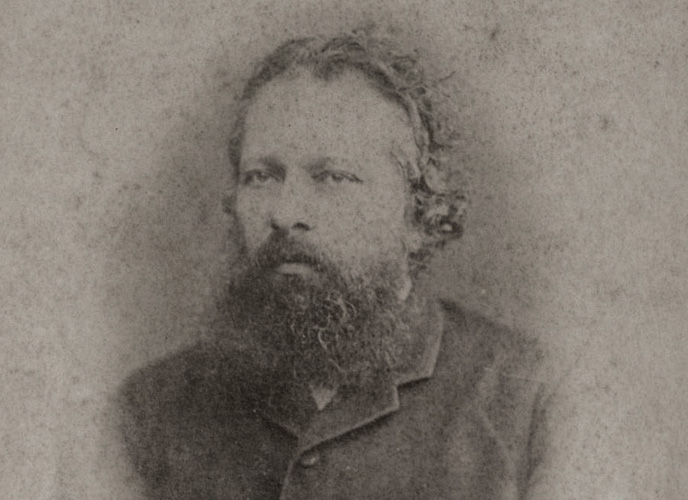
Namık Kemal
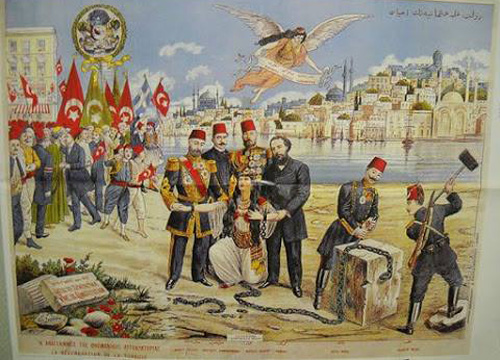
A postcard from 1908 celebrating the Second Constitutional revolution which has Kemal at the center.
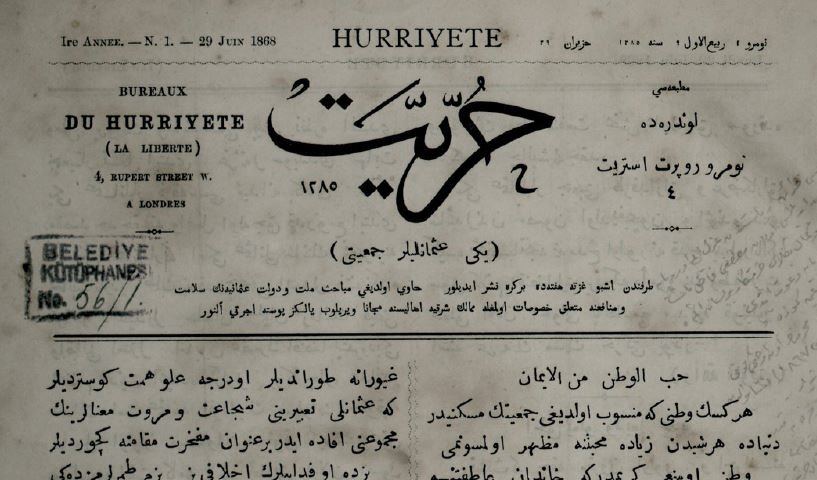
The first issue of Hürriyet.
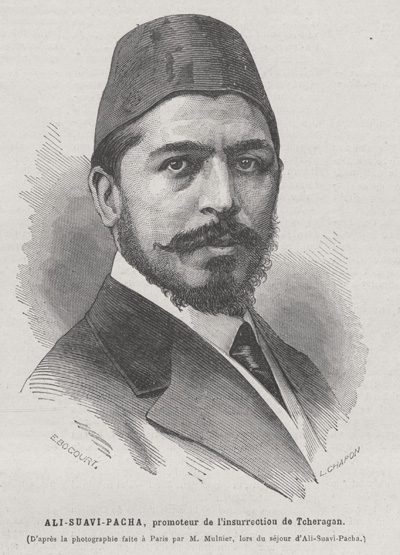
Ali Suavi
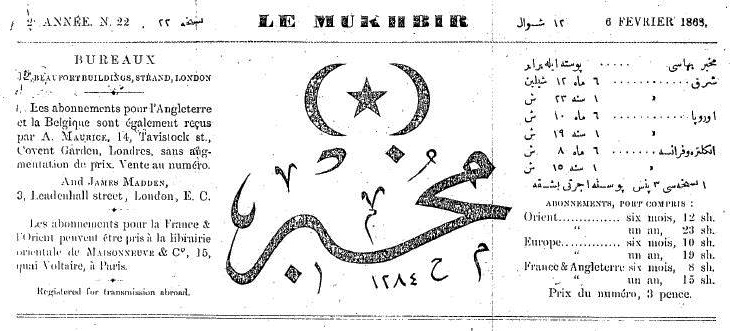
Masthead of Le Mukhbir
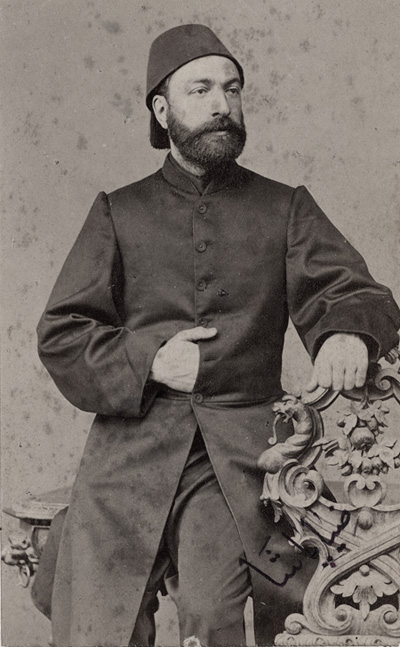
Ziya Paşa
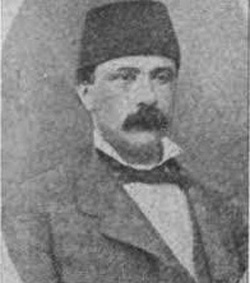
Teodor Kasap